
Motivational Interviewing for Peer Support: Honoring Autonomy and Inspiring Change (4 CE Hours)

- 1 Section
- 8 Lessons
- 1 Quiz
- 4h Duration
Motivational Interviewing for Peer Support: Honoring Autonomy and Inspiring Change (4 CE Hours)
- Module 1: The Soul of MI: Partnership, Acceptance, Compassion, and Evocation (PACE)
- Video Overview of Module 1
- Module 2: The Core Skills of MI: OARS and Deep Listening
- Video Overview of Module 2
- Module 3: Focusing and Evoking: Amplifying Change Talk
- Video Overview of Module 3
- Module 4: Planning and Commitment: Paving the Path with Peer Support
- Video Overview of Module 4
- Post-Test: Motivational Interviewing for Peer Support
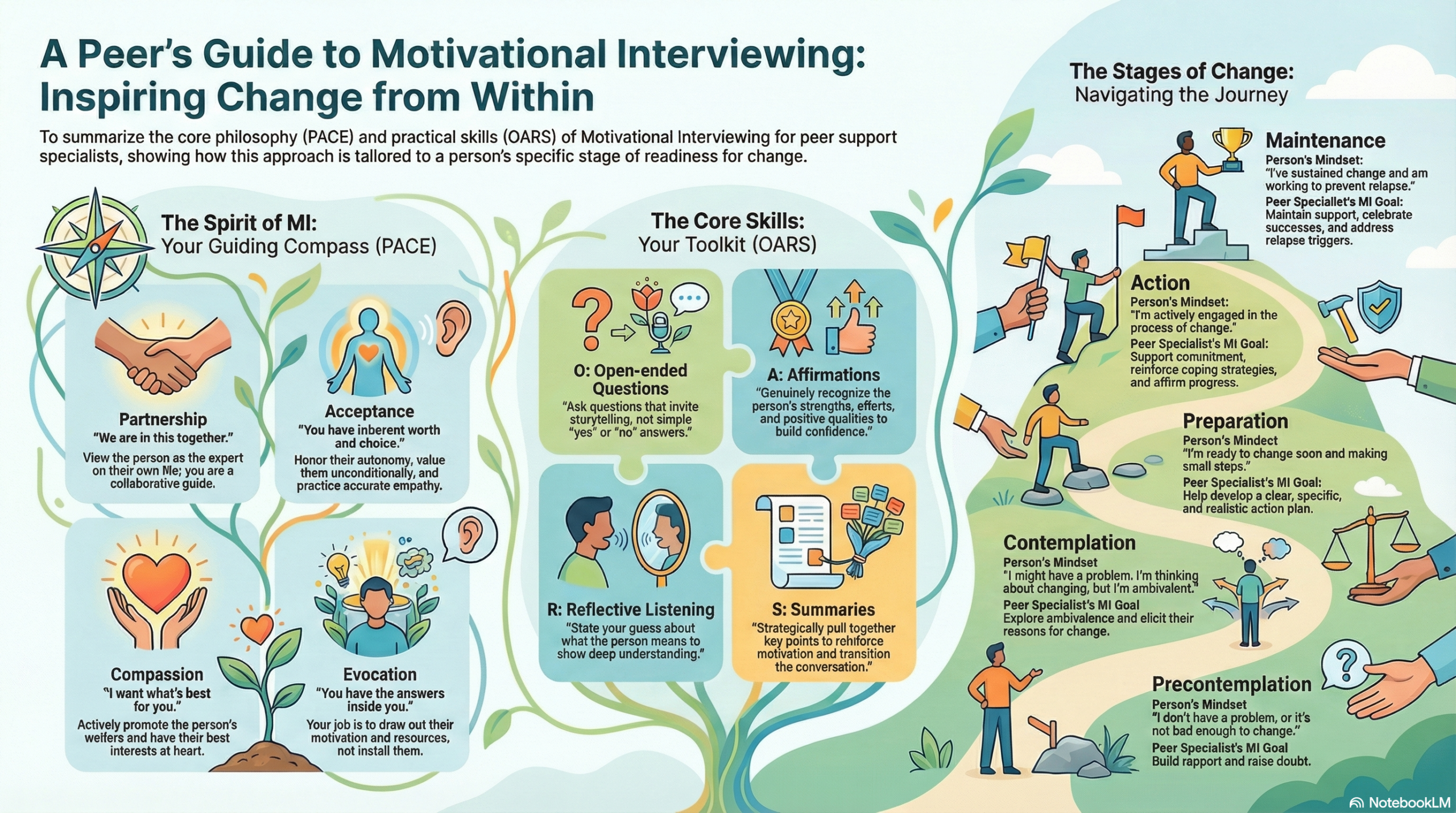
This course introduces Motivational Interviewing (MI) as an evidence-based, person-centered style of communication that aligns seamlessly with the non-hierarchical, collaborative spirit of peer support. The curriculum is designed to integrate MI into the CRPS's daily practice, formalizing their intuitive skills to create a structured catalyst for change. The course begins by establishing the core philosophical context, the Spirit of MI (PACE), which prevents techniques from becoming coercive and ensures ethical practice. A major focus is on navigating ambivalence (the internal conflict about change) by exploring it with curiosity rather than confrontation. Participants learn to strategically use the fundamental communication micro-skills known as OARS (Open-ended Questions, Affirmations, Reflective Listening, and Summarizing) to amplify the person's own reasons for change (Change Talk). The final modules equip the CRPS to recognize readiness signals, transition collaboratively into the planning process, and support the peer in maintaining change and recovering from setbacks using the Stages of Change model.
Want to submit a review? Login
Related Courses
Professional Responsibilities for Resiliency Advocates (3 Contact Hours)
Work through ethical dilemmas with the FCB Code of Ethics and a seven-step model
Maintain professional boundaries around dual relationships, gifts, and social media
Meet Florida child abuse reporting duties and protect privacy under HIPAA and FERPA
Resiliency Support for Resiliency Advocates (3 Contact Hours)
Coach coping and emotion regulation skills and model healthy responses to stress
Encourage positive behavior and redirect problems calmly, without shame
Guide goal setting with if-then plans and strengths-based problem solving
Behavioral Observations for Resiliency Advocates (3 Contact Hours)
Record objective, bias-aware observations with the ABC method
Stay situationally aware through active supervision and precorrection
Spot signs of distress, trauma responses, suicide risk, and possible abuse or neglect