
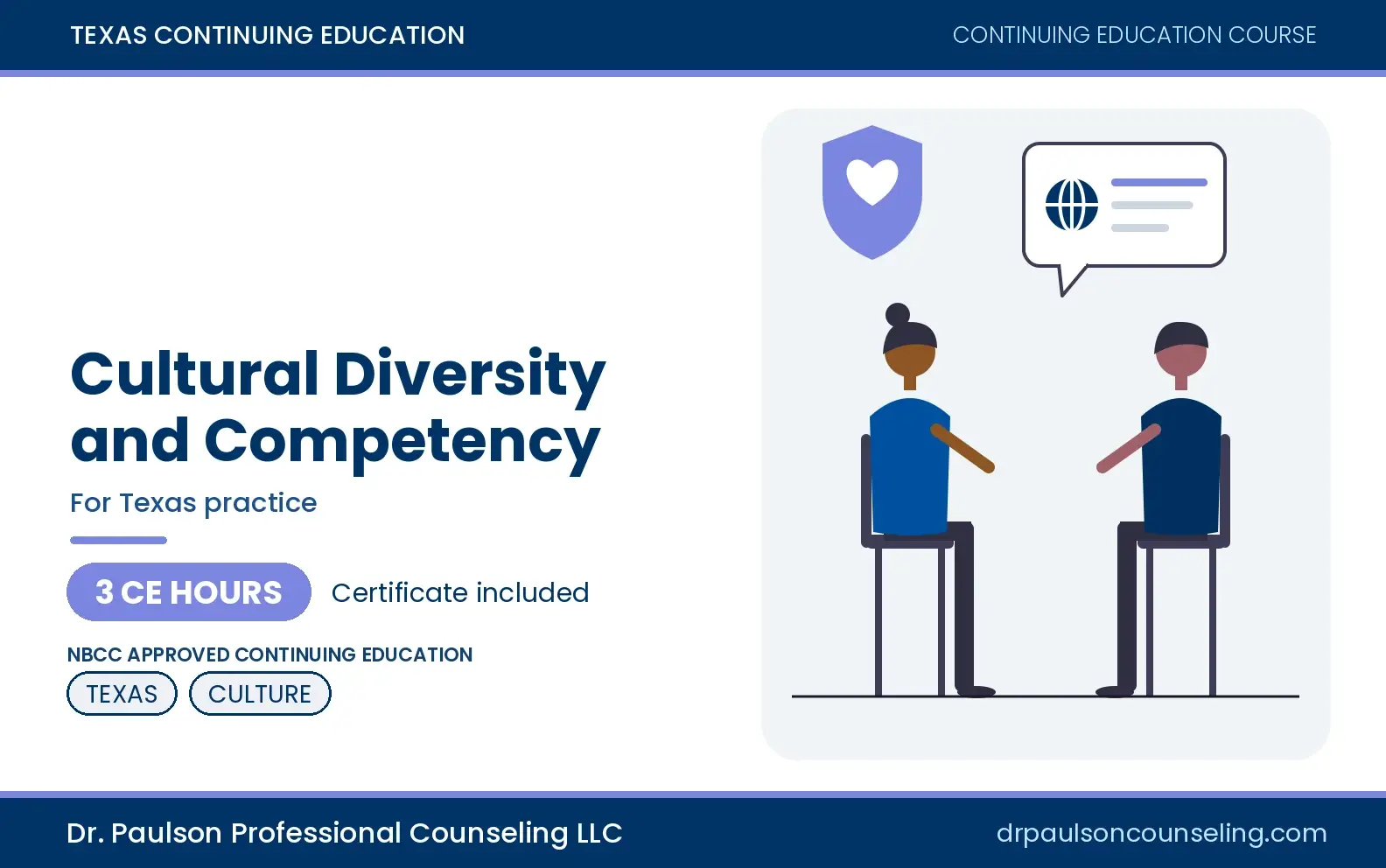
Cultural Diversity and Competency in Texas Practice (3 CE Hours)

- 1 Section
- 4 Lessons
- 2 Quizzes
- 3h Duration
Cultural Diversity and Competency in Texas Practice
- Course Overview & Introduction
- Module 1: The New Standard: Texas Regulations, MSJCC Framework, and Self-Awareness
- Module 2: The Invisible Dynamics: Intersectionality, Power, and Implicit Bias
- Module 3: Competence in Action: Adapting Interventions and Social Justice Advocacy
- Post Test: Cultural Diversity and Competency in Texas Practice
- Program Evaluation
This 3-hour continuing education course is built around the Texas Behavioral Health Executive Council (BHEC) rule, effective July 20, 2025, that LPCs, LMFTs, and social workers complete 3 hours designed to ensure competency when providing services to a distinct population. The Council does not pre-approve courses, so each licensee decides which training fits the population they choose. Moving beyond introductory awareness, this course utilizes the Multicultural and Social Justice Counseling Competencies (MSJCC) framework to explore the complexities of intersectionality, implicit bias, and power dynamics within the therapeutic relationship. Participants will examine the 2025 amendments to the Texas Administrative Code continuing education rules, analyze the impact of historical and systemic oppression on mental health, and develop actionable skills for culturally responsive care. Through a systems approach, clinicians will learn to adapt interventions for diverse client groups prevalent in Texas, ensuring ethical compliance and enhanced clinical outcomes. Upon successful completion of the post-test, hours are reported directly to CE Broker.
CE Broker reporting covers the 16 boards in 10 states where I'm a registered provider. Everyone gets a certificate to download right away.
State Board and Certification Requirements
Each licensing board and certification body sets its own continuing education rules. Our provider approvals and CE Broker reporting do not guarantee that this course will be accepted for your specific license, renewal period, or required topic. Please check your board’s current rules before you enroll. Questions? Email info@drpaulsoncounseling.com.
Want to submit a review? Login
Reviews
-
October 23, 2026 5:34 pm
Good
Good job
-
October 12, 2026 10:51 am
The number of new concepts was very information.
Navigating and learning how to answer questions took some time. The site tended to buffer which was frustrating.
-
October 11, 2026 11:46 pm
Good
I had some minor glitches.
-
October 5, 2026 8:22 pm
Met expectatiopns
Consise layout of course
-
September 28, 2026 9:29 pm
Licensed Professional Counselor
Great training overall! It's helpful to gain new knowledge about how cultural diversity has been growing, particularly in Texas, and enjoyed how this training gives insight towards how to become more competent while working with diverse populations.


Related Courses
Healing through Family & Community for Arizona Professionals (6 CE Hours)
Foundations of Client, Family, and Community Education
The Continuum of Care and Managed Care
Referrals and Care Coordination
AI and Clinical Documentation in Ohio: Ethics, Risks, and Responsible Use (4 Hours) -Ohio
Applies Ohio rule OAC 4757-5-09 to AI-drafted notes: the licensee develops and approves every note.
Explains the CSWMFT Board's AI guidance and proposed AI rules.
Shows why client information does not go into consumer chatbots, and what to do instead.
Theoretical Frameworks and Models of Clinical Supervision (6 Hours) -West Virginia
Supervisors apply social role models to select among teaching, counseling, and consulting stances based on supervisee need rather than habit.
Professionals assess developmental stage by domain and set the supervisory environment slightly beyond current functioning to prompt growth.
Clinical educators recognize the strengths and limits of psychodynamic, cognitive behavioral, person-centered, and systemic supervision traditions.