

CRPS Advocacy: Empowering Peers and Navigating Systems (4 CE Hours)
Distinguish clearly between the non-clinical roles of peer support and the functions of traditional addiction counseling, minimizing role confusion and enhancing team collaboration.
Master confidentiality mandates (including HIPAA compliance) and strategies for managing the dual relationships and appropriate self-disclosure inherent in peer work.
Implement principles of Trauma-Informed Care (TIC) and employ specific safety protocols and assertive re-engagement strategies to support vulnerable peers during acute distress.

The Peer's Power: Practical Trauma-Informed Care for the Certified Recovery Peer Specialist (CRPS) (4 CE Hours)
Trauma Paradigm Shift: Moving from a deficit-based model to a strengths-based model by focusing on the underlying trauma rather than the symptom.
SAMHSA Six Principles: Integrating the principles of TIC—especially Safety, Trustworthiness, and Empowerment, Voice, & Choice—to create a collaborative, non-hierarchical, and corrective relationship.
Neurobiology and SUD: Understanding the Self-Medication Hypothesis and recognizing challenging behaviors as primitive survival responses (Fight, Flight, Freeze, Fawn) rather than defiance or resistance.
Motivational Interviewing for Peer Support: Honoring Autonomy and Inspiring Change (4 CE Hours)
The Spirit of MI (PACE): Establishing the foundational philosophy of Partnership, Acceptance, Compassion, and Evocation.
OARS Toolkit Mastery: Fluently using Open-ended Questions, Affirmations, Reflections (especially complex reflections), and Summaries to deepen listening and operationalize the MI spirit.
Evoking Change Talk: Learning to elicit and reinforce Preparatory Change Talk (DARN: Desire, Ability, Reasons, Need) and Mobilizing Change Talk (CAT: Commitment, Activation, Taking Steps).
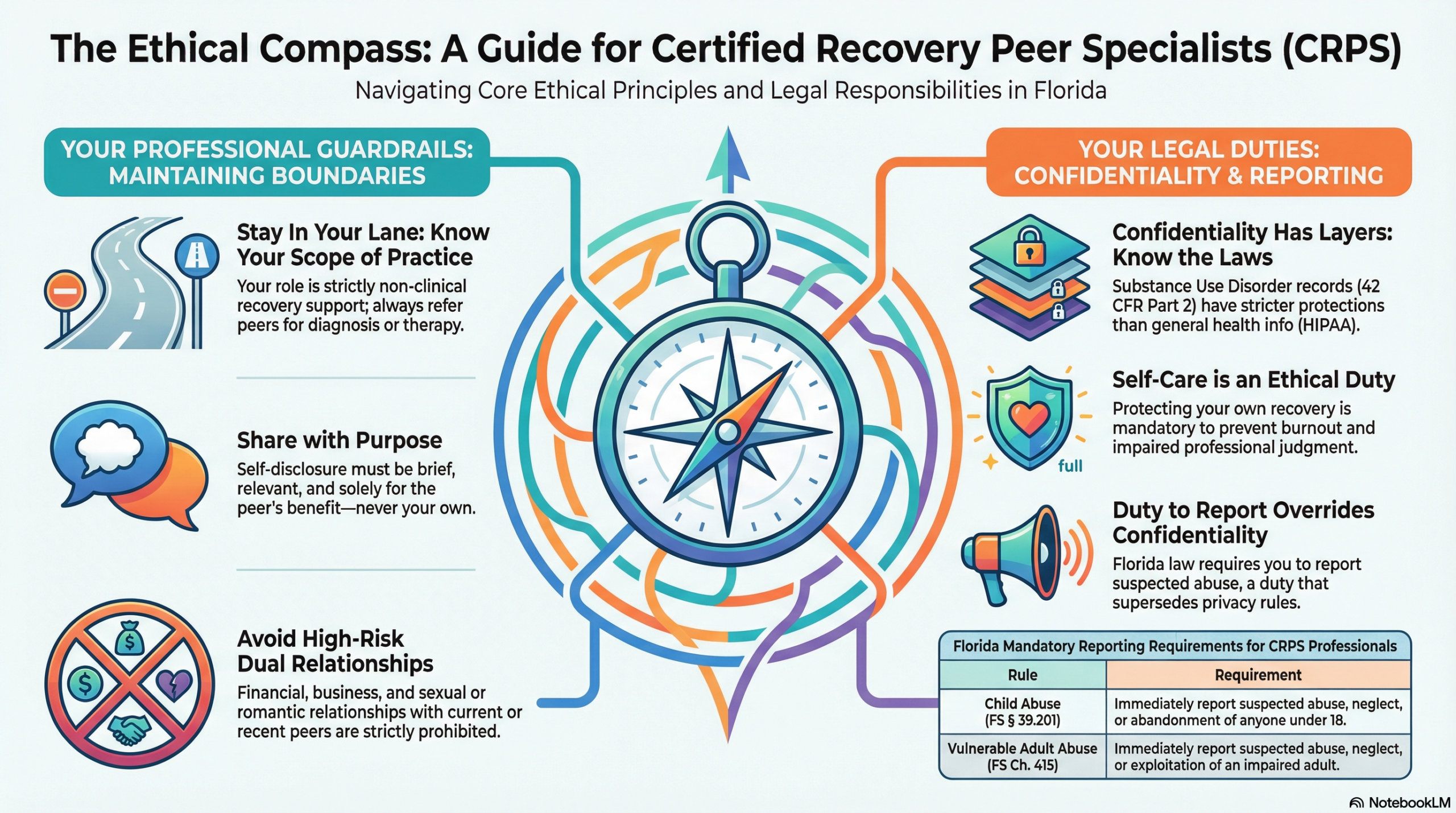
The Peer Professional: Ethical and Legal Responsibilities for the Certified Recovery Peer Specialist (CRPS) in Florida (4 CE Hours)
Confidentiality Framework: Differentiating between the legal protections of HIPAA and the strict requirements of 42 CFR Part 2 for SUD records, and understanding the impact of the 2024 Final Rule on sharing records for integrated care.
Mandatory Reporting: Applying Florida Statutes that legally require the CRPS to report suspected child abuse/neglect and vulnerable adult abuse/exploitation, which supersedes confidentiality rules
Boundary Integrity: Maintaining a non-clinical Scope of Practice, avoiding strictly prohibited dual relationships (financial/sexual), and using self-disclosure ethically (Relevant, Brief, Purposeful)