
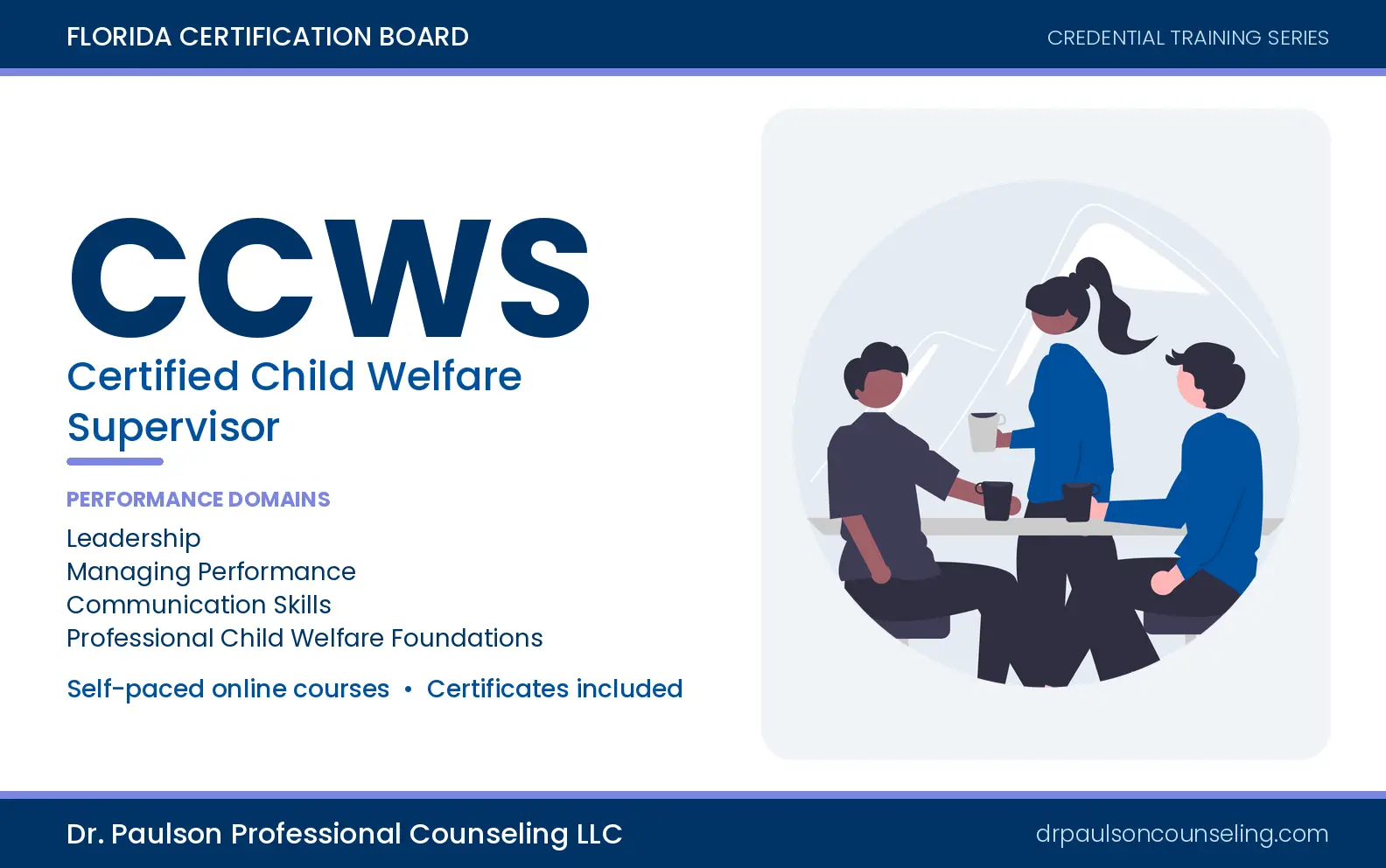
Professional Child Welfare Foundation for Supervisors (8 Contact Hours)

- 1 Section
- 10 Lessons
- 2 Quizzes
- 8h Duration
Course Content
- Course Overview & Introduction
- Module 1: Florida's Child Welfare System: Structure and Roles
- Module 2: The Big Picture: Safety, Permanency, and Well-Being Outcomes
- Module 3: Modeling Florida's Child Welfare Practice Model
- Module 4: Core Safety Concepts in Supervision
- Module 5: Supervision Models for Child Welfare
- Module 6: Teaching Strategies for Child Welfare Staff
- Module 7: Applying Federal Law in Casework
- Module 8: Applying Florida Statute and Agency Policy in Casework
- References
- Post Test
- Program Evaluation
Florida child welfare supervisors lead staff inside a system of state, private, judicial, and community organizations while applying the Child Welfare Practice Model, Chapter 39 timelines, and federal requirements. This 8-contact-hour course gives Certified Child Welfare Supervisors and supervisory candidates the professional foundation for that work.
Participants learn the roles of DCF, community-based care lead agencies, case management organizations, and dependency courts, including the 2023 transfer of all child protective investigations to DCF. They connect daily casework to Florida's statutory and federal outcomes, model the Practice Model and its core safety concepts, apply supervision models and teaching strategies, and apply federal law and Chapter 39 correctly. Each module includes a case study and a practical tool such as the Safety Decision Consultation Guide and the Chapter 39 Timeline Tracker.
Want to submit a review? Login
Related Courses
Professional Responsibilities for Resiliency Advocates (3 Contact Hours)
Work through ethical dilemmas with the FCB Code of Ethics and a seven-step model
Maintain professional boundaries around dual relationships, gifts, and social media
Meet Florida child abuse reporting duties and protect privacy under HIPAA and FERPA
Resiliency Support for Resiliency Advocates (3 Contact Hours)
Coach coping and emotion regulation skills and model healthy responses to stress
Encourage positive behavior and redirect problems calmly, without shame
Guide goal setting with if-then plans and strengths-based problem solving
Behavioral Observations for Resiliency Advocates (3 Contact Hours)
Record objective, bias-aware observations with the ABC method
Stay situationally aware through active supervision and precorrection
Spot signs of distress, trauma responses, suicide risk, and possible abuse or neglect