
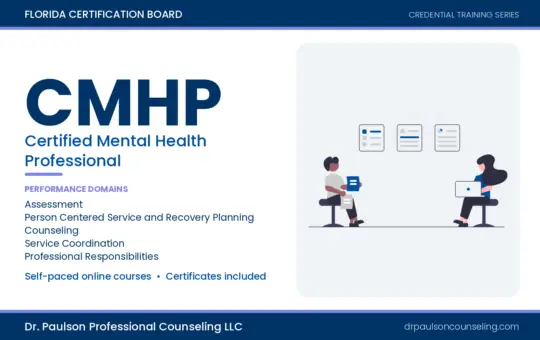
Certified Mental Health Professional (CMHP)
The CMHP is designed for educated, experienced providers working directly with people living with mental health conditions. Our courses offer robust preparation in psychological assessment, person-centered service and recovery planning, service coordination, and professional readiness, preparing you to deliver high-quality, compassionate care. To pursue this credential, candidates must hold at minimum a bachelor's degree in a related field. While the CMHP reflects an advanced level of competency in mental health services, it does not allow for independent practice. All CMHPs are required to work within a licensed treatment agency or community mental health center. In accordance with Florida Certification Board (FCB) standards, our training is delivered exclusively via compliant self-paced online courses; "homestudy" formats are no longer accepted. To successfully verify learning and earn a certificate of completion, participants must pass a post-test with a minimum score of 70% and complete a Level One evaluation (attitude questionnaire).
Grief, Loss, and Life Transitions (10 Contact Hours)

Learners will describe grief as a normal response to loss and explain current models of grieving, including Worden's tasks, the dual process model, and continuing bonds.
Learners will recognize anticipatory, ambiguous, disenfranchised, secondary, and traumatic losses and respond with validation and practical support.
Learners will identify signs that grief may need clinical attention, including Prolonged Grief Disorder features and suicide risk, and route these concerns to licensed clinicians.
Identifying Co-Occurring Mental Health and Substance Use Disorders (10 Contact Hours)
Screen every client for both mental health and substance use concerns
Build symptom and substance timelines for licensed clinicians
Engage ambivalent clients using stages of change and motivational skills
Standardized Screening for Mental Disorders (10 Contact Hours)
Distinguish screening, assessment, and diagnosis within the CMHP scope
Administer and score the PHQ-9, GAD-7, PC-PTSD-5, PCL-5, and AUDIT-C accurately
Respond immediately to positive suicide risk screens under agency protocol
Foundations of Biopsychosocial Assessment (10 Contact Hours)
Organize assessment data across biological, psychological, and social domains
Conduct structured interviews with informed consent and clear confidentiality limits
Apply trauma-informed and culturally responsive questioning
Writing Measurable Goals and SMART Objectives (10 Contact Hours)
Learners will distinguish visions, goals, objectives, and interventions and connect each level of a service plan to the person's own intentions.
Learners will write SMART objectives that name an observable behavior, a measurable amount, the conditions, and a target date.
Learners will track progress with simple, person-friendly measures and write progress notes that link directly to plan objectives.
The Philosophy of Person-Centered Care (10 Contact Hours)
Learners will trace the history of person-centered care from Rogers's core conditions to SAMHSA's working definition of recovery and the CHIME framework.
Learners will practice a structured listening cycle and recovery-oriented language that keep the person, not the diagnosis, at the center of every contact.
Learners will apply shared decision-making, cultural humility, and trauma-informed principles within the limits of the CMHP role.
Clinical Formulation and Level of Care Placement (10 Contact Hours)
Organize assessment information using the four Ps framework
Understand the continuum of care, ASAM Criteria, and LOCUS
Support shared decision-making in the least restrictive safe setting
Identifying Barriers to Recovery (10 Contact Hours)
Learners will reframe "noncompliance" as barriers to be understood and use a recognized framework to organize predisposing, enabling, and need factors.
Learners will screen for practical and social barriers such as transportation, cost, housing, food, and documentation, and link people to resources.
Learners will explore attitudinal, stigma-related, symptom-related, and co-occurring barriers with respectful, motivational questions.
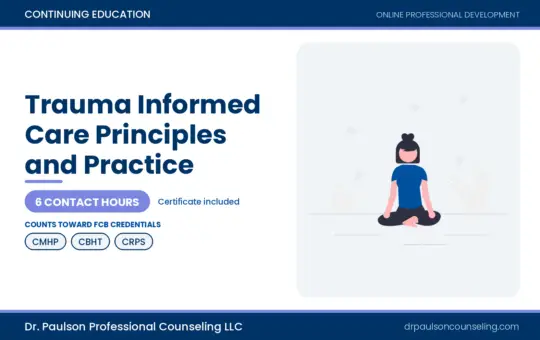
Trauma Informed Care Principles and Practice (6 Contact Hours)
Master the core principles of trauma-informed care to enhance client safety and therapeutic engagement.
Analyze the neurological and behavioral impacts of trauma to better conceptualize client presentation.
Implement evidence-based strategies to avoid re-traumatizing clients within the behavioral health system.
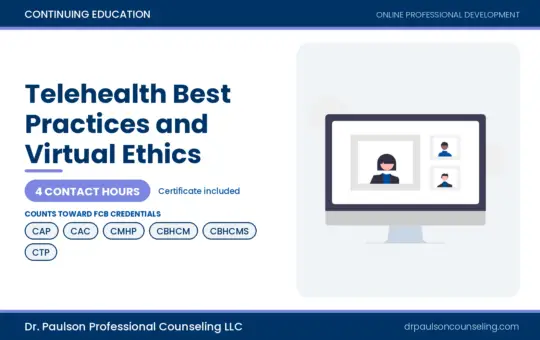
Telehealth Best Practices and Virtual Ethics (4 Contact Hours)
Learners will master the clinical modification skills required to translate evidence-based, face-to-face therapeutic interventions into a secure virtual environment.
Professionals will implement robust digital privacy protocols to ensure strict compliance with the Health Insurance Portability and Accountability Act (HIPAA) and 42 CFR Part 2 regulations.
Clinicians will navigate complex out-of-state jurisdictional rules and establish rigorous boundary management strategies to prevent ethical violations.
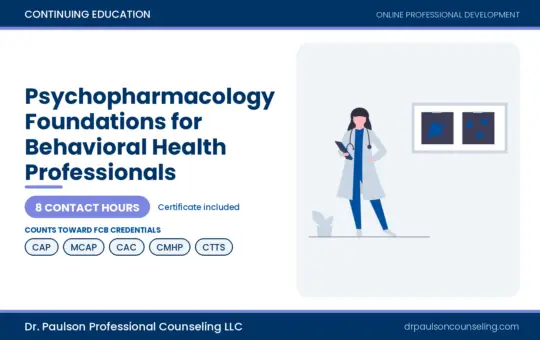
Psychopharmacology Foundations for Behavioral Health Professionals (8 Contact Hours)
Master the biological mechanisms of action and common side effects of primary psychoactive medications used in addiction and mental health treatment.
Identify complex and potentially lethal interactions between prescribed psychotropic medications and illicit substances.
Develop collaborative communication strategies to partner effectively with psychiatric prescribers and multidisciplinary medical teams.
Managing Behavioral Crises and Suicide Prevention (6 Contact Hours)
Learn to execute comprehensive suicide risk assessments using validated tools like the Columbia-Suicide Severity Rating Scale.
Master verbal de-escalation techniques to safely manage agitated clients and prevent physical behavioral emergencies.
Formulate collaborative safety plans that empower clients and restrict access to lethal means.