
North Carolina Board of Licensed Clinical Mental Health Counselors
Culturally Sensitive Assessment and Treatment of Intimate Partner Violence (2 Hours)

Current 2023/2024 NISVS prevalence data explained
Step-by-step training in danger assessment and personalized safety planning
Practical guidance for culturally responsive screening with interpreters
Chronic Pain Syndromes and Interventions: Treating the Whole Person (3 Hours)
Plain-language tools for explaining pain science to clients
Ready-to-use PEG tracking and biopsychosocial formulation methods
Pain-informed suicide risk assessment and safety planning
North Carolina Ethics for Clinical Mental Health Counselors (3 Contact Hours)
Counselors apply G.S. 90-329 et seq., 21 NCAC 53, and the Board's adoption of the ACA Code.
Practitioners protect privileged records under G.S. 8-53.8 and respond correctly to a subpoena.
Clinicians know the 2023 parental consent law for minors and North Carolina reporting duties.
Spiritually Integrated Clinical Practice: Assessment, Interventions, and Ethics (5 Hours)
Fills the 5-hour yearly multi-media allowance for Tennessee LCPTs (Rule 0450-03-.12)
Spiritual assessment tools and religious experience vs. psychopathology
Religiously integrated CBT, forgiveness, moral injury, and scrupulosity treatment
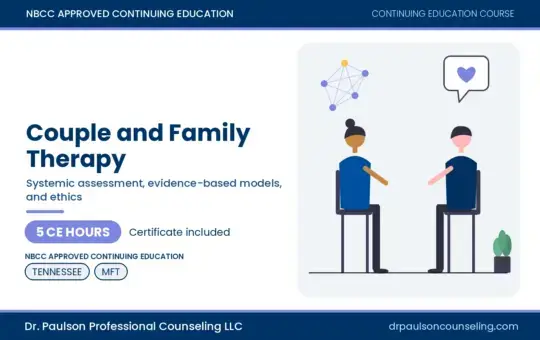
Couple and Family Therapy: Systemic Assessment, Evidence-Based Models, and Ethical Practice (5 Hours)
Fills the 5-hour yearly multi-media allowance for Tennessee LMFTs (Rule 0450-02-.12)
EFT, Gottman, IBCT, FFT, MST, BSFT, MDFT, ABFT, and more
Practical tools and case studies in every module
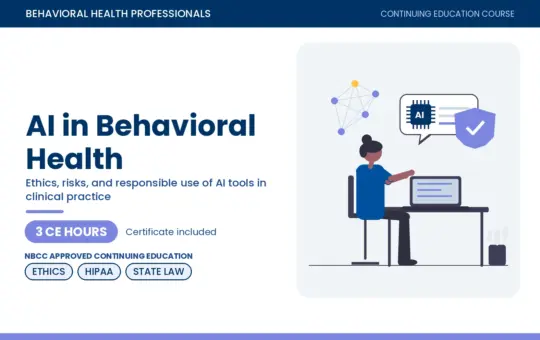
AI in Behavioral Health: Ethics, Risks, and Responsible Use (3 Hours)
Designed around Arizona's technology continuing education requirement (R4-6-802) beginning January 1, 2027
Explains Arizona's AI informed consent rule and Illinois, Nevada, Utah, Texas, and Tennessee AI laws
Covers HIPAA business associate agreements and privacy risks for AI scribes and chatbots
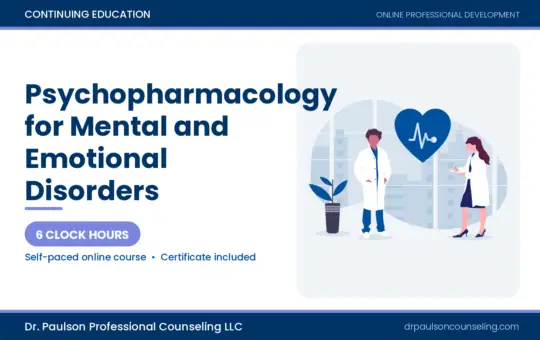
Psychopharmacology for Mental and Emotional Disorders (6 Contact Hours)
Specialized instruction on the mechanisms of antidepressants, antianxiety agents, and mood stabilizers.
Professionals learn to evaluate somatic symptoms and medication side effects, an approach supported by the Substance Abuse and Mental Health Services Administration (2014) in trauma-informed care settings, to differentiate between behavioral pathology and physiological responses.
Integrating this medical knowledge helps clinical staff coordinate care with prescribing physicians to address complex co-occurring conditions, a collaborative process the Center for Substance Abuse Treatment (2006) identifies as necessary for treating systemic barriers safely and effectively.
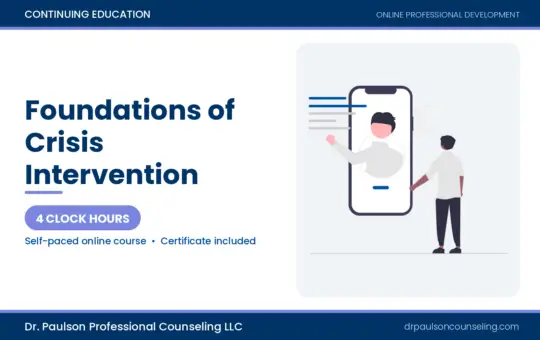
Foundations of Crisis Intervention (4 Contact Hours)
Specialized instruction on field-based models, de-escalation techniques, and lethality assessment are provided.
Professionals learn to evaluate physical safety risks and manage intense affective flooding during active emergencies.
Structured protocols guide the assessment of suicidal intent and homicidal ideation to protect the broader community.
Assessment and Diagnosis of Trauma (4 Contact Hours)
Course highlights include specialized instruction on the neurobiology of trauma, differentiating posttraumatic stress from acute stress, and recognizing comorbid disorders.
Professionals utilize standardized screening instruments like the PCL-5 and conduct structured clinical interviews safely.
Formulating actionable objectives based on the SMART goal framework ensures treatment plans directly address immediate safety and long-term stabilization needs.
The Dynamics of Stress (4 Contact Hours)
Course highlights include specialized instruction on the autonomic nervous system's fight-or-flight response, cognitive responses to trauma, and severe emotional regulation difficulties.
Professionals learn to differentiate between normal survival reactions and abnormal behavioral pathology, an approach supported by professionals during active emergencies.
Evaluating environmental and systemic factors helps clinical staff coordinate care to address sociological barriers such as housing instability, ensuring comprehensive client support.
Suicide Assessment, Treatment, and Management (1 Contact Hour)
Participants identify specific suicide risk assessment protocols delineated by behavioral health research and clinical standards.
The curriculum details the legal and ethical limits of confidentiality when assessing clients who present a clear and imminent danger to themselves or others.
Clinicians analyze crisis intervention strategies necessary for securing client safety and managing homicidal or suicidal ideation.