
Florida Certification Board
As an FCB Approved Provider, our course catalog is specifically curated to meet the renewal standards for Certified Behavioral Health Technicians (CBHT), Certified Recovery Peer Specialists (CRPS — including adult, family, and veteran tracks), Certified Addiction Professionals and Counselors (CAP/CAC), and Certified Tobacco Treatment Specialists (CTTS). Every course is expertly developed by Dr. Brian Paulson and designed to deliver evidence-based, real-world training that not only satisfies your credential requirements but genuinely advances your clinical practice. All courses are fully online and self-paced, allowing you to complete your required hours on your own schedule. Upon finishing a course, your official certificate is available for immediate download — no waiting required. Browse our catalog below to find the training that fits your credential and continue making a meaningful impact in the lives of those you serve.
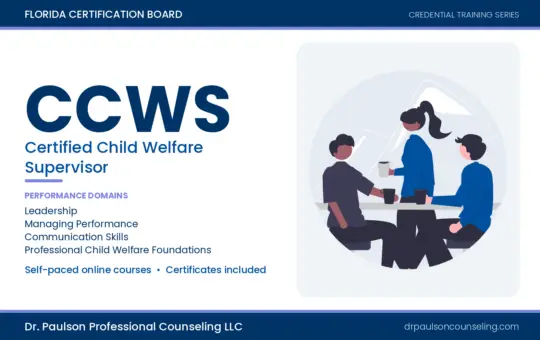
Professional Child Welfare Foundation for Supervisors (8 Contact Hours)

Learners will describe the roles of Florida's child welfare organizations and connect casework to statewide safety, permanency, and well-being outcomes.
Learners will model Florida's Child Welfare Practice Model and apply its core safety concepts in supervisory consultation.
Learners will apply supervision models and teaching strategies to develop child welfare staff.
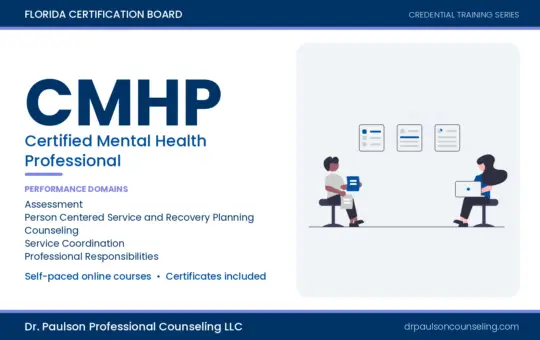
Crisis Intervention and De-escalation (10 Contact Hours)
Learners will apply the seven tasks of crisis intervention and a triage approach to immediate safety within the CMHP role.
Learners will use the ten domains of verbal de-escalation along with calm nonverbal communication and safe environments.
Learners will provide psychological first aid and adapt responses for psychosis, intoxication, suicidal crisis, and cognitive impairment.
Solution-Focused Brief Interventions (10 Contact Hours)
Learners will describe the assumptions and evidence base of solution-focused brief therapy.
Learners will use miracle, exception, scaling, coping, and relationship questions to help people describe goals and progress.
Learners will develop well-formed goals and small next steps in the person's own words.
Dialectical Behavior Skills Training (10 Contact Hours)
Learners will describe the biosocial theory and the acceptance-and-change balance that underlie DBT.
Learners will use validation to reduce emotional escalation and strengthen collaboration.
Learners will explain core skills from the four DBT modules and support people in practicing them in daily life.
Cross-Cultural Counseling Competencies (10 Contact Hours)
Learners will describe multicultural counseling competence and the Multicultural and Social Justice Counseling Competencies framework.
Learners will examine their own cultural identities, biases, and privilege and recognize cultural encapsulation.
Learners will recognize microaggressions, oppression, and socioeconomic barriers and respond in affirming ways.
Cultural Humility and Social Justice (10 Contact Hours)
Learners will describe cultural humility and explain how it differs from a static view of cultural competence.
Learners will examine their own identities, positions, and assumptions and recognize how bias and microaggressions affect helping relationships.
Learners will apply intersectionality and social determinants of health to understand clients' experiences and barriers.
Self-Care and Professional Longevity (10 Contact Hours)
Learners will explain why self-care is an ethical responsibility under the FCB Code and professional literature.
Learners will distinguish burnout, compassion fatigue, secondary traumatic stress, vicarious trauma, compassion satisfaction, and vicarious resilience.
Learners will recognize personal warning signs and use evidence-informed recovery, self-compassion, and wellness strategies.
Boundary Management in Community Care (10 Contact Hours)
Learners will distinguish boundary crossings from boundary violations and recognize the warning signs of boundary drift in community practice.
Learners will apply the FCB Code's boundary, exploitation, and social media provisions to home visits, overlapping communities, and digital communication.
Learners will use decision tools to respond to hospitality, gifts, requests for favors, self-disclosure, and physical contact in ways that protect clients and relationships.
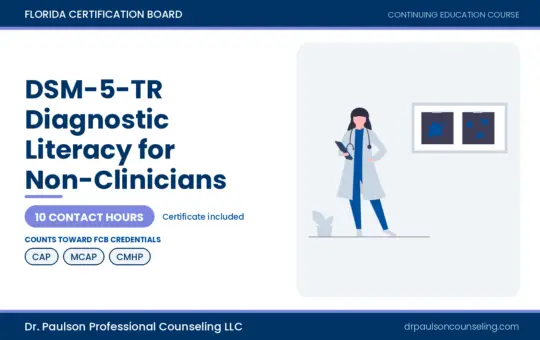
DSM-5-TR Diagnostic Literacy for Non-Clinicians (10 Contact Hours)
Standardized diagnostic literacy establishes a clear clinical baseline to support collaborative treatment planning.
Systematic classification techniques assist in recognizing how symptoms manifest across childhood, adulthood, and late life.
Identifying social determinants through Z-codes reveals environmental factors that influence psychological well-being.
Privacy and Confidentiality: HIPAA and 42 CFR Part 2 (10 Contact Hours)
Learners will describe the HIPAA Privacy Rule's core concepts, including protected health information, permitted uses for treatment, payment, and health care operations, and the minimum necessary standard.
Learners will explain how 42 CFR Part 2 protects substance use disorder records and what changed under the 2024 final rule.
Learners will apply Florida confidentiality laws and federal rules to common CMHP situations, including family requests, emergencies, subpoenas, and mandatory reporting.
Monitoring Referral Efficacy and Outcomes (10 Contact Hours)
Learners will distinguish open-loop from closed-loop referrals and describe the steps and follow-up timeline of a closed-loop referral process.
Learners will define referral success at the levels of connection, engagement, and outcome, and track referral data accurately.
Learners will analyze referral failures using person, provider, and system factors and simple root cause tools.
The FCB Code of Ethics for the CMHP (10 Contact Hours)
Learners will describe the purpose, scope, and key definitions of the FCB Code of Ethical and Professional Conduct, including who is considered a client.
Learners will apply the Rules on professional standards, criminal activity reporting, boundaries, sexual misconduct, exploitation, fraud, safety, and records to common CMHP situations.
Learners will explain the FCB complaint, investigation, sanction, appeal, and reinstatement processes and their professional consequences.