
Florida Certification Board
As an FCB Approved Provider, our course catalog is specifically curated to meet the renewal standards for Certified Behavioral Health Technicians (CBHT), Certified Recovery Peer Specialists (CRPS — including adult, family, and veteran tracks), Certified Addiction Professionals and Counselors (CAP/CAC), and Certified Tobacco Treatment Specialists (CTTS). Every course is expertly developed by Dr. Brian Paulson and designed to deliver evidence-based, real-world training that not only satisfies your credential requirements but genuinely advances your clinical practice. All courses are fully online and self-paced, allowing you to complete your required hours on your own schedule. Upon finishing a course, your official certificate is available for immediate download — no waiting required. Browse our catalog below to find the training that fits your credential and continue making a meaningful impact in the lives of those you serve.
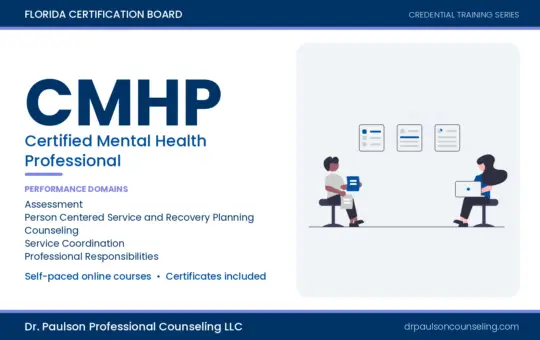
Navigating Florida's Social Service Systems (10 Contact Hours)

Learners will describe how Florida's major public assistance systems are organized and which agencies determine eligibility for each.
Learners will support people through applications, renewals, and required reporting for Medicaid, the Medically Needy program, SNAP, and Social Security disability benefits.
Learners will connect people with housing, substance use, crisis, and legal resources through active, consent-based linkage.
Florida Statutes and the Baker Act (10 Contact Hours)
Learners will describe the Florida statutes that govern behavioral health services and the CMHP's place within them.
Learners will explain the criteria for involuntary examination under the Baker Act and identify who may initiate an examination.
Learners will describe the examination process, dispositions, patient rights, and the differences between the Baker Act and the Marchman Act.
Advocating for Client Rights and Resources (10 Contact Hours)
Learners will describe advocacy within the CMHP role, including the difference between acting with a person and acting on their behalf.
Learners will identify key rights of people receiving mental health and substance use services in Florida and core disability rights protections.
Learners will coach people in self-advocacy and support them through grievances, complaints, and appeals.
Interdisciplinary Collaboration and Teamwork (10 Contact Hours)
Learners will describe the core competencies of interprofessional collaboration and the roles of common behavioral health team members.
Learners will apply structured communication tools to report observations clearly and objectively to licensed clinicians and teams.
Learners will contribute effectively to team meetings, integrated care, and family partnerships while following privacy law and consent requirements.
Reviewing and Updating the Service Plan (10 Contact Hours)
Learners will identify when plan reviews are required and what events should trigger an earlier review.
Learners will prepare data and the person for reviews using progress summaries, outcome monitoring, and structured feedback.
Learners will apply decision guidelines to continue, revise, or retire objectives and rewrite objectives in SMART form for clinician approval.
Crisis Planning and Wellness Recovery (10 Contact Hours)
Learners will describe the nature of crisis, the crisis services continuum, and the CMHP's role and limits in crisis situations.
Learners will support clinician-developed safety plans and help people build personal wellness and crisis plans in their own words.
Learners will identify early warning signs, crisis preferences, and substance-related risks, including overdose, and connect people to appropriate resources.
Introduction to Evidence-Based Practices (10 Contact Hours)
Learners will define evidence-based practice as the integration of research evidence, clinical expertise, and the person's characteristics, culture, and preferences.
Learners will evaluate claims about treatments using basic concepts of research design and levels of evidence.
Learners will describe several SAMHSA-recognized evidence-based program models and the CMHP's role within them.
Strengths-Based Assessment and Planning (10 Contact Hours)
Learners will describe the strengths perspective and the six principles of the Strengths Model and contrast them with deficit-focused approaches.
Learners will conduct a strengths assessment across life domains and map a person's recovery capital.
Learners will use exception, coping, and success-focused questions to elicit strengths from people who struggle to see any.
Motivational Interviewing in Planning (10 Contact Hours)
Learners will describe the spirit and four processes of motivational interviewing and map them onto the service planning conversation.
Learners will practice open questions, affirmations, reflections, and summaries to engage people and strengthen their own reasons for change.
Learners will recognize change talk and sustain talk and respond to ambivalence and discord without arguing.
The Role of the CMHP in Service Coordination (10 Contact Hours)
Learners will describe service coordination, its core functions, and the CMHP's role and scope within it.
Learners will compare major case management models and explain what the evidence suggests about each.
Learners will apply coordination-focused needs assessment, planning, linkage, and monitoring skills that keep the person at the center.
Cognitive Behavioral Foundations (10 Contact Hours)
Learners will explain the cognitive model and the behavioral principles that underlie cognitive behavioral approaches.
Learners will help people notice automatic thoughts and common thinking patterns and support clinician-assigned thought records.
Learners will support behavioral activation, relaxation, problem-solving, and social skills practice in everyday settings.
Mental Status Examination (MSE) Techniques (10 Contact Hours)
Observe and describe each mental status domain objectively
Distinguish mood from affect and thought process from thought content
Recognize acute confusion, command hallucinations, and other urgent findings