
Navigating Mississippi Counseling Ethics and Legal Frameworks (6 Education Hours)

Learners will evaluate the ethical decision-making models required to resolve complex clinical dilemmas safely.
Learners will interpret Mississippi state statutes and board regulations governing distance professional services and clinical supervision.
Learners will formulate strategies to navigate limits of confidentiality and mandated reporting within your therapeutic practice.
Advanced Clinical Supervision Ethics and Methods (2 Clock Hours)
Participants will analyze advanced supervision methods to foster counselor development and clinical competence.
Supervisors will implement structured self-evaluation techniques to improve their own supervisory effectiveness.
Practitioners will apply the American Counseling Association (ACA) code of ethics to complex supervisory dilemmas.
Mastering Diagnosis and Treatment of Substance Use Disorders (8 Credit Hours)
Participants will accurately apply diagnostic criteria to identify substance use disorders and co occurring conditions.
Professionals will utilize comprehensive assessment tools to determine appropriate levels of clinical care.
Counselors will implement the core skills of motivational interviewing to resolve client ambivalence.
Treating Nicotine Dependence and Co-Occurring Disorders (4 Contact Hours)
Assess the neurobiological and clinical intersections of tobacco addiction and co-occurring behavioral health disorders.
Implement targeted motivational interviewing techniques to resolve ambivalence and enhance commitment to tobacco cessation.
Formulate comprehensive treatment plans that integrate pharmacotherapy options, behavioral interventions, and relapse prevention strategies.
Telehealth Best Practices and Virtual Ethics (4 Contact Hours)
Learners will master the clinical modification skills required to translate evidence-based, face-to-face therapeutic interventions into a secure virtual environment.
Professionals will implement robust digital privacy protocols to ensure strict compliance with the Health Insurance Portability and Accountability Act (HIPAA) and 42 CFR Part 2 regulations.
Clinicians will navigate complex out-of-state jurisdictional rules and establish rigorous boundary management strategies to prevent ethical violations.
Psychopharmacology Foundations for Behavioral Health Professionals (8 Contact Hours)
Master the biological mechanisms of action and common side effects of primary psychoactive medications used in addiction and mental health treatment.
Identify complex and potentially lethal interactions between prescribed psychotropic medications and illicit substances.
Develop collaborative communication strategies to partner effectively with psychiatric prescribers and multidisciplinary medical teams.
Managing Behavioral Crises and Suicide Prevention (6 Contact Hours)
Learn to execute comprehensive suicide risk assessments using validated tools like the Columbia-Suicide Severity Rating Scale.
Master verbal de-escalation techniques to safely manage agitated clients and prevent physical behavioral emergencies.
Formulate collaborative safety plans that empower clients and restrict access to lethal means.
Intervening in Domestic Violence for Behavioral Health (3 Contact Hours)
Master the identification of early warning signs and complex dynamics associated with domestic violence.
Implement evidence-based screening instruments to safely assess individuals experiencing intimate partner violence.
Formulate comprehensive, trauma-informed safety plans to protect vulnerable clients and their families.
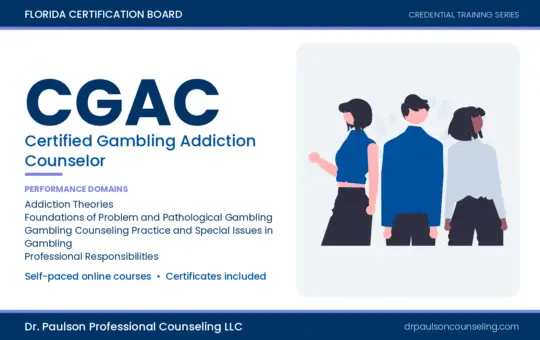
Navigating Finances, Legalities, Crises, and Suicide Prevention (12 Contact Hours)
Participants will execute evidence-based crisis intervention strategies to rapidly stabilize clients experiencing acute suicidality and profound psychological distress.
Clinicians will systematically dismantle the financial devastation of gambling by implementing structured debt restitution and money protection plans.
Counselors will navigate the criminal justice system effectively by utilizing motivational interviewing with court-mandated clients while balancing public safety and public health mandates.
Navigating Specific Issues in Problem Gambling (12 Contact Hours)
Learners will evaluate the unique biopsychosocial risk factors across special populations to tailor highly specific gambling treatment plans.
Learners will apply advanced cognitive-behavioral and mindfulness-based relapse prevention strategies to effectively manage client cravings and high-risk situations.
Learners will navigate complex legal and financial crises, including restitution planning and forensic reporting, while maintaining strict ethical boundaries.
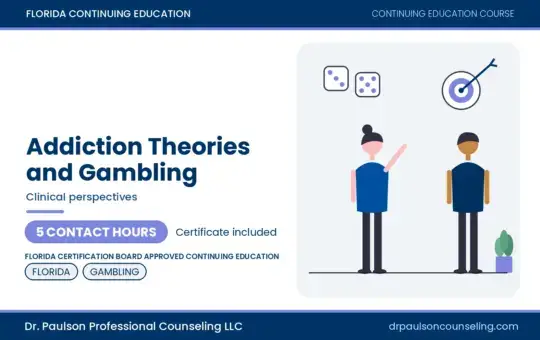
Addiction Theories and Gambling: Clinical Perspectives (5 Contact Hours)
Learners will evaluate the macroscopic relationship between gambling disorder, severe psychiatric comorbidities, physical health decline, and systemic social problems including family dissolution.
Learners will analyze the specific financial and legal consequences of gambling addiction, including the progression toward illegal acts and involvement with the criminal justice system.
Learners will master the DSM-5-TR diagnostic criteria for gambling disorder, identifying key clinical signs such as tolerance, withdrawal, and the phenomenon of chasing losses.
Addiction Theories and Gambling (5 Contact Hours)
Master the neurobiological mechanisms and brain science that drive the development and maintenance of behavioral addictions.
Evaluate the complex etiology of gambling disorder utilizing the biopsychosocial framework and the revised Pathways Model.
Implement evidence-based therapeutic modalities, including Cognitive Behavioral Therapy and Motivational Interviewing, to restructure cognitive distortions and resolve client ambivalence.