
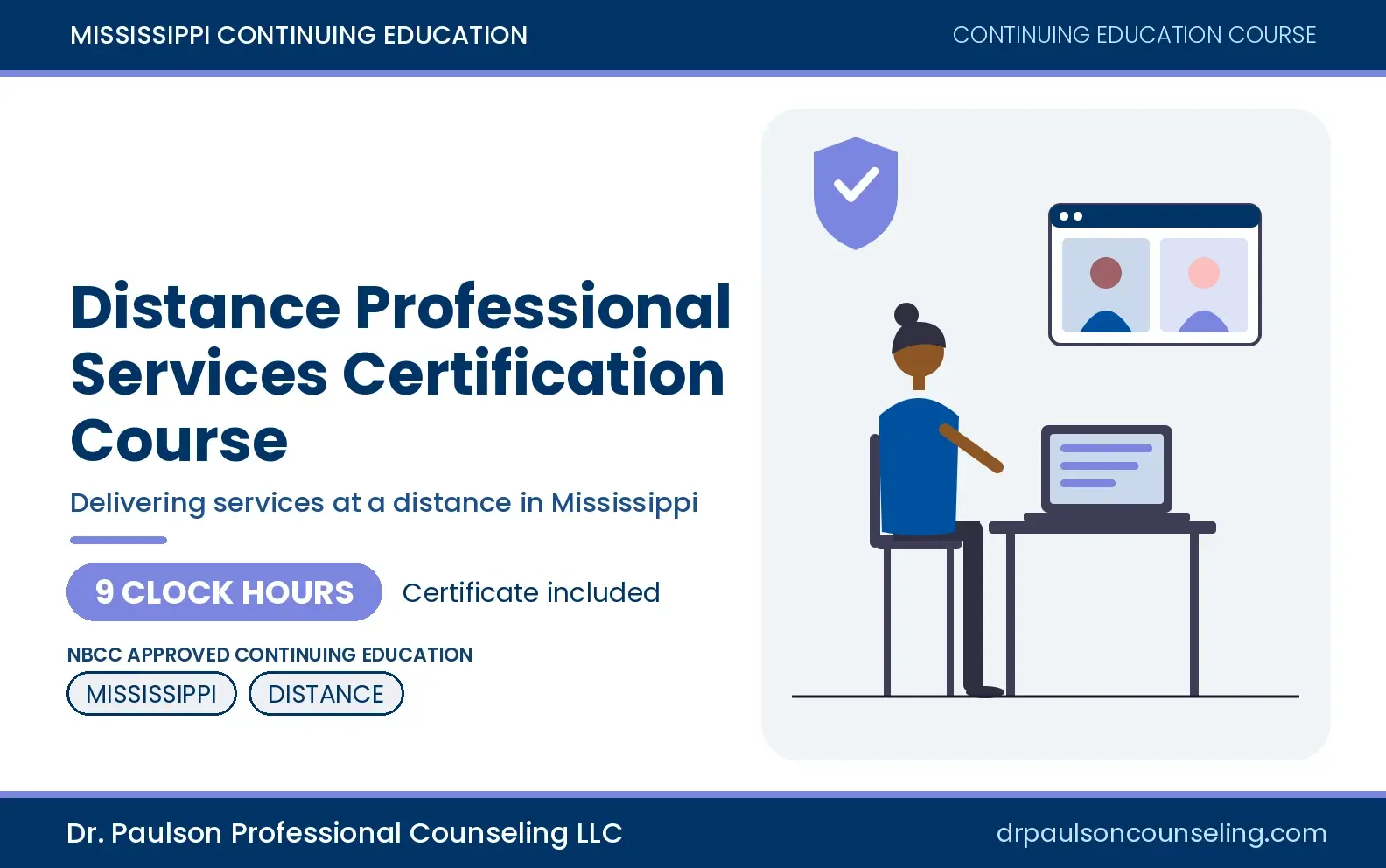
Mississippi Distance Professional Services Certification Course (9 Clock Hours)

- 1 Section
- 11 Lessons
- 2 Quizzes
- 9h Duration
Mississippi Distance Professional Services Certification Course
- Course Overview & Introduction
- Module 1 Introduction to Telemental Health Settings
- Module 2 Appropriateness of Distance Professional Services
- Module 3 Choosing and Using Telehealth Technology
- Module 4 Orienting Clients to Virtual Care
- Module 5 HIPAA Compliance for Telemental Health
- Module 6 Ethical and Legal Distance Counseling
- Module 7 NBCC Policy and Ethical Mandates
- Module 8 Crisis Planning and Remote Protocols
- Module 9 Distance Clinical Supervision Requirements
- References
- Post-Test: Mississippi Distance Professional Services Certification Course 9 Credit Hours
- Program Evaluation
Virtual therapy is a primary method of care that requires advanced technical competencies to protect client confidentiality. This nine hour training helps you navigate the complexities of distance counseling and clinical supervision. You will maintain excellence from a distance while managing vulnerabilities like data interception. Completing this curriculum will allow you to meet the Mississippi mandate for nine clock hours of professional training required to secure your distance provider designation (Mississippi State Board of Examiners for Licensed Professional Counselors [MSBLPC], 2025). Upon successful completion of the post-test, hours are reported directly to CE Broker.
CE Broker reporting covers the 16 boards in 10 states where I'm a registered provider. Everyone gets a certificate to download right away.
Want to submit a review? Login
Reviews
-
Oct 21, 2026 @ 12:46 am
The experience was. great
This was easy to navigate and informative.

Related Courses
Florida Qualified Supervisor Renewal Training (4 Hours)
Four hours of supervisory training for the every-third-biennium renewal requirement
Covers every renewal topic listed in Fla. Admin. Code R. 64B4-6.0025
Current Florida rules on interns, supervision, and electronic supervision
Prevention of Medical Errors for Florida Mental Health Professionals (2 Hours)
Types of errors in mental health practice
Root-cause analysis and just culture
Error reduction: checklists, SBAR, and safe handoffs
Domestic Violence for Florida Mental Health Professionals (2 Hours)
National and Florida domestic violence data
Dynamics, coercive control, and lethality indicators
Screening tools and safe screening practice