
Instructor | Dr. Brian Paulson, Ph.D.
Resiliency Support for Resiliency Advocates (3 Contact Hours)

Coach coping and emotion regulation skills and model healthy responses to stress
Encourage positive behavior and redirect problems calmly, without shame
Guide goal setting with if-then plans and strengths-based problem solving
Behavioral Observations for Resiliency Advocates (3 Contact Hours)
Record objective, bias-aware observations with the ABC method
Stay situationally aware through active supervision and precorrection
Spot signs of distress, trauma responses, suicide risk, and possible abuse or neglect
Healthy Relationships for Resiliency Advocates (3 Contact Hours)
Build caring, trusting connections through developmental relationship practices
Communicate with young people using active listening, validation, and emotion coaching
Set healthy boundaries and model calm co-regulation in youth settings
Foundational Resiliency Knowledge for Resiliency Advocates (4 Contact Hours)
Explain resiliency theory and the protective factors that help young people recover
Trace child and adolescent development and the ways toxic stress disrupts it
Recognize Adverse and Positive Childhood Experiences and respond with trauma-informed care
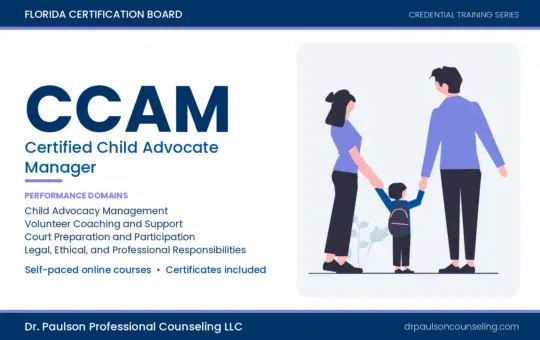
Volunteer Coaching, Relationship Building, Management, and Support for CCAMs (10 Contact Hours)
Learners will apply research-based volunteer management practices linked to retention.
Learners will recruit, screen, and onboard guardian ad litem volunteers in line with Florida law.
Learners will coach volunteers using motivational interviewing skills and build their confidence and independence.
Court Preparation and Participation for CCAMs (10 Contact Hours)
Learners will track the stages and statutory timelines of Florida dependency cases.
Learners will write and review specific, balanced guardian ad litem court reports.
Learners will prepare volunteers and children for court and support honest, composed testimony.
Legal, Ethical, and Professional Responsibilities for CCAMs (10 Contact Hours)
Learners will apply the guardian ad litem's legal duties and the FCB Code of Ethical and Professional Conduct.
Learners will protect confidential records and maintain professional boundaries.
Learners will manage conflicts of interest, meet mandatory reporting duties, and practice fairly.
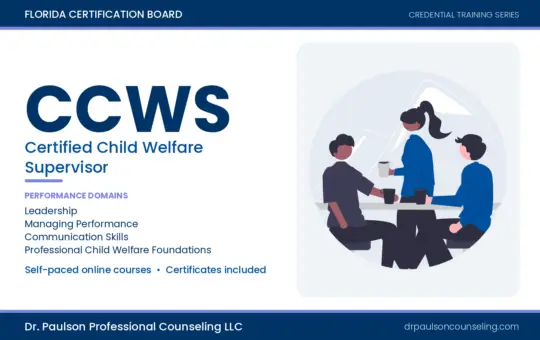
Managing Performance for Child Welfare Supervisors (14 Contact Hours)
Learners will communicate clear expectations, assign work to match skill and experience, and conduct supervisory reviews at Florida's critical case junctures.
Learners will recognize when multidisciplinary team staffings are required under section 39.4022, Florida Statutes.
Learners will evaluate staff fairly using informal feedback, formal evaluations, and quantitative and qualitative performance information.
Leadership for Child Welfare Supervisors (10 Contact Hours)
Learners will use motivational strategies, active listening, and strengths-based supervision to inspire staff performance.
Learners will maintain professional boundaries and apply emotional intelligence in relationships with staff, managers, and peers.
Learners will lead consistently with child welfare laws, policies, and ethics and build a shared vision across a diverse workforce.
Communication Skills for Child Welfare Supervisors (8 Contact Hours)
Learners will write and review accurate, objective case documentation and court reports that support sound decisions for children.
Learners will use active listening, reflections, summaries, and appropriate tone with staff, families, caregivers, and partners.
Learners will apply the need-to-know standard, informed consent, and discretion to protect families and staff.
Child Advocacy Management for Certified Child Advocate Managers (10 Contact Hours)
Learners will apply the fiduciary best interest standard and report children's preferences under section 39.822, Florida Statutes.
Learners will match volunteers to cases, gather and verify information, and conduct child visits that meet mandatory reporting duties.
Learners will track cases against Chapter 39 timelines and advocate in multidisciplinary staffings.
Professional Child Welfare Foundation for Supervisors (8 Contact Hours)
Learners will describe the roles of Florida's child welfare organizations and connect casework to statewide safety, permanency, and well-being outcomes.
Learners will model Florida's Child Welfare Practice Model and apply its core safety concepts in supervisory consultation.
Learners will apply supervision models and teaching strategies to develop child welfare staff.