
Instructor | Dr. Brian Paulson, Ph.D.
Prescription Opioids for New Jersey Counselors: Risks, Misuse, Addiction, and Diversion (1 Contact Hour)

Written for New Jersey's 1 contact hour on prescription opioid drugs (P.L. 2017, c.341).
Counselors recognize the signs of opioid misuse, addiction, and diversion.
Practitioners screen with the TAPS Tool and refer to MOUD and ReachNJ.

New Jersey Ethics for Professional Counselors (5 Contact Hours)
Counselors apply the N.J.A.C. 13:34 rules and the CE requirements for the November 30, 2026 renewal, including the 5 ethics hours.
Practitioners handle records requests and subpoenas under N.J.R.E. 534, HIPAA, and 42 CFR Part 2.
Clinicians know why the duty to warn statute does not name counselors and what to do anyway.
AI in Behavioral Health: Ethics, Risks, and Responsible Use (3 Clock Hours) -Pennsylvania
Explains how existing Pennsylvania ethics, confidentiality, and recordkeeping rules apply to AI tools
Reviews pending Pennsylvania bills (HB 1925 and SB 1090) and Department of State action on unlicensed chatbots, with other states' laws as examples
Covers HIPAA business associate agreements and privacy risks for AI scribes and chatbots
Couple and Family Therapy: Systemic Assessment, Evidence-Based Models, and Ethical Practice (5 Clock Hours) -Pennsylvania
Five clock hours of marriage and family therapy content for Pennsylvania LMFTs, LPCs, and social workers
EFT, Gottman, IBCT, FFT, MST, BSFT, MDFT, ABFT, and more
Practical tools and case studies in every module
Gambling Addiction Treatment: A Brief Review (2 Clock Hours) -Pennsylvania
Explains why Gambling Disorder moved from impulse control disorders to addictive disorders, and the brain changes it shares with substance use.
Reviews the nine diagnostic criteria for Gambling Disorder, including chasing losses and bailouts.
Trains clinicians on screening and assessment tools such as the South Oaks Gambling Screen (SOGS) and the NODS.
Foundations of Crisis Intervention (4 Clock Hours) -Pennsylvania
Specialized instruction on field-based models, de-escalation techniques, and lethality assessment are provided.
Professionals learn to evaluate physical safety risks and manage intense affective flooding during active emergencies.
Structured protocols guide the assessment of suicidal intent and homicidal ideation to protect the broader community.
Assessment and Diagnosis of Trauma (4 Clock Hours) -Pennsylvania
Course highlights include specialized instruction on the neurobiology of trauma, differentiating posttraumatic stress from acute stress, and recognizing comorbid disorders.
Professionals utilize standardized screening instruments like the PCL-5 and conduct structured clinical interviews safely.
Formulating actionable objectives based on the SMART goal framework ensures treatment plans directly address immediate safety and long-term stabilization needs.
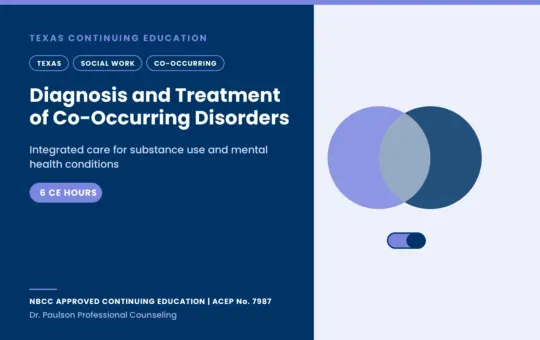
Diagnosis and Treatment of Co-Occurring Disorders (6 Clock Hours) -Pennsylvania
Uses the Quadrant Model of Care to match clients with co-occurring disorders to the right level of services.
Builds skills in differential diagnosis, separating substance-induced symptoms from independent psychiatric disorders.
Clarifies Pennsylvania scope of practice for LPCs, LMFTs, LCSWs, LSWs, and LBSWs, and how they work with DDAP-licensed drug and alcohol programs.
Pennsylvania Professional Ethics for Counselors, MFTs, and Social Workers (3 Clock Hours)
Clinicians apply the Pennsylvania codes of ethical practice and the CE rules for the February 28, 2027 renewal, including the 20 clock hour home study limit.
Practitioners handle releases, records requests, and subpoenas under the Mental Health Procedures Act, HIPAA, 42 CFR Part 2, and Act 65 of 2020.
Professionals identify when Pennsylvania law calls for a warning or a mandated report and document the decision with a step by step template.
Addiction Therapies and 12-Step Modalities (5 CE Hours)
Participants will integrate 12-step facilitation and group therapy dynamics into comprehensive, individualized addiction treatment plans.
Learners will evaluate the neurobiological and cognitive mechanisms driving both substance use and process addictions, particularly gambling and disordered eating.
Practitioners will utilize the Transtheoretical Model and CBT to manage cravings, identify high-risk situations, and develop practical relapse prevention plans.
Crisis Counseling and Immediate Stabilization (5 CE Hours)
Participants will apply the Hybrid Model of Crisis Intervention to rapidly assess physical safety and stabilize highly dysregulated clients in short-term therapeutic settings.
Learners will utilize specific, collaborative communication strategies to de-escalate severe emotional distress and facilitate immediate client coping.
Counselors will implement emergency telehealth protocols to manage remote crises safely and in compliance with Kansas BSRB jurisdictional regulations.
Resolving Systemic Dynamics in Couples and Families (4 CE Hours)
Learners will implement structural and transgenerational family systems theories to conceptualize rigid boundaries, enmeshment, and chronic triangulation within distressed family units.
Learners will utilize Behavioral Couple Therapy (BCT) and communication skills training to resolve severe relational conflict and address substance use within cohabiting relationships.
Learners will apply Solution-Focused Brief Therapy (SFBT) and Narrative Therapy techniques to externalize systemic problems and build resilience in blended and culturally diverse families.